
AEO Jargon Explained: The 4 Metrics That Actually Matter

Marc-Olivier Bouchard
LLM AI Ranking Strategy Consultant
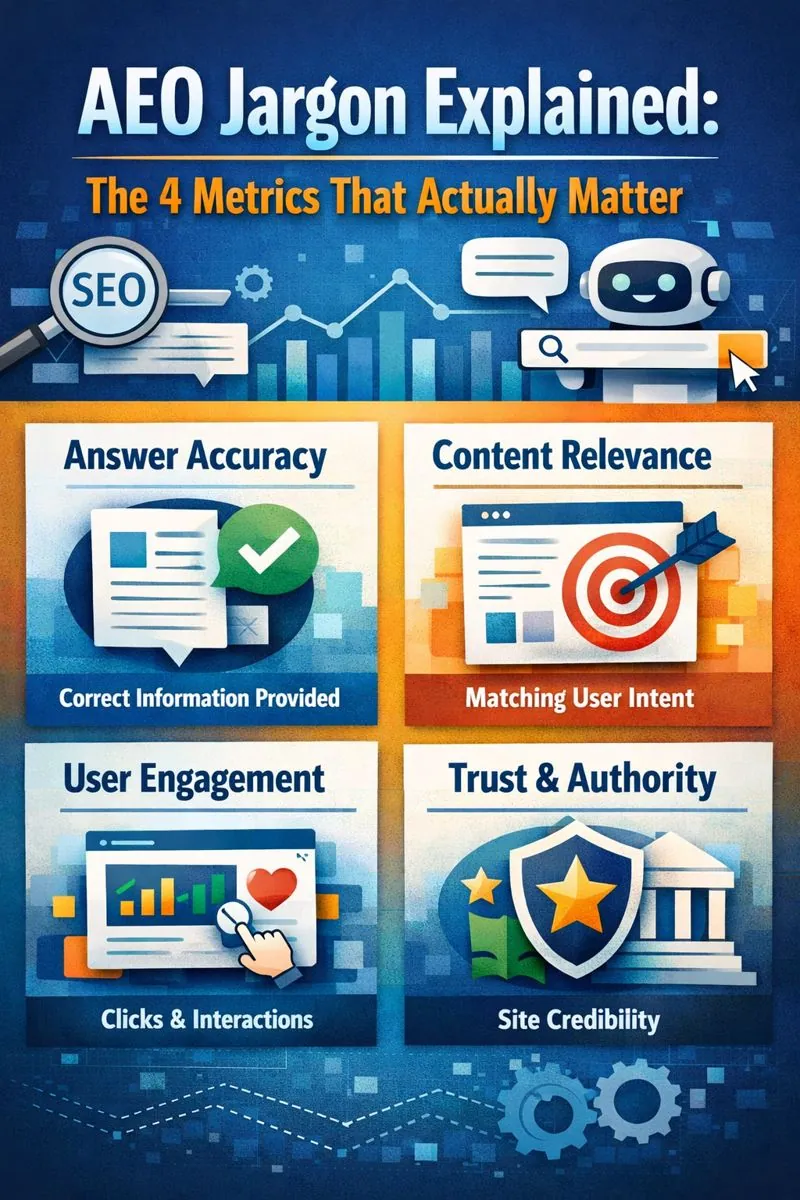
AEO tools throw around a lot of jargon. Four metrics actually matter — and each one has a direct SEO equivalent, an exact formula, and research-backed benchmarks. Learn these four. Everything else is noise.
Why AEO Metrics Are Different from SEO Metrics
Traditional SEO optimizes for position in a ranked list of links — measured by keyword rank, organic click-through rate, and domain authority. Answer Engine Optimization (AEO) optimizes for citation in AI-generated responses — a fundamentally different output that requires different measurement.
The scale of that difference is concrete. Google AI Overviews now appear in over 85% of searches, yet only 15% of AI Overview sources overlap with the traditional Top 10 organic results (platform-algorithms research, 2025). Ranking #1 for a keyword provides no guarantee of appearing in the AI answer displayed above it.
These four metrics measure what actually matters in that new reality.
Metric #1: AI Visibility Score
What it measures: How often your brand appears across a monitored set of AI-generated responses.
This is your primary metric. It is to AEO what impression share is to paid search — a percentage that tells you how much of the available opportunity you are capturing.
Formula
AI Visibility Score = (AI responses mentioning your brand ÷ Total prompts tested) × 100
Test 20 prompts. Your brand appears in 8 AI responses. Visibility Score = 40%.
Research-backed benchmarks
Princeton University's GEO research (Aggarwal et al., 2024) validated that systematic optimization — adding citations, statistics, and answer-first structure — increases AI visibility by up to 40% for established sites and up to 115% for low-visibility brands. Those are the realistic improvement targets when starting from a low baseline.
SEO equivalent: Impression share
Old SEO: track 100 keywords, appear in the top 10 for 40. Impression share = 40%.
New AEO: test 20 prompts, appear in 8 AI answers. Visibility Score = 40%.
Same concept, different platform, different measurement. Track this weekly. It is your north-star metric.
Metric #2: Brand Mentions
What it measures: Every instance where an AI engine names your brand in a response — regardless of whether your site is cited as the source.
Brand Mentions count raw presence and frequency. A brand mentioned 47 times across 100 payment queries has 47 opportunities to create an impression — regardless of whether a clickable link appears.
Why the number matters more than you think
SE Ranking research across 129,000 domains found that branded domains receive 11.1 more citation points than third-party sources mentioning the same brand. Brands that appear frequently in AI responses build a self-reinforcing authority signal: mention frequency raises the probability of direct citation on the next prompt.
SEO equivalent: Branded search volume
Old SEO: count how many users search for your brand name. High branded search volume = strong offline awareness driving online intent.
New AEO: count how many AI responses name your brand. High brand mention frequency = strong AI-mediated awareness driving citation authority.
If AI engines never say your brand name, users following AI recommendations never encounter it. Track this weekly. It is your awareness metric.
Metric #3: Citation Share
What it measures: How often your content — your actual pages — is referenced as the source in AI-generated answers.
Citation Share distinguishes between being mentioned (AI says your name) and being cited (AI links to or attributes your content as its source). Citation is the stronger signal: it indicates that the AI model trusts your content enough to present it as evidence.
Formula
Citation Share = (AI answers citing your content ÷ Total answers tracked) × 100
What the research says about improving it
Princeton University's GEO study tested 9 optimization methods across 10,000+ queries. Adding authoritative citations to content increased AI visibility by up to 40% — the single highest-impact method tested. The implication is recursive: pages that cite credible sources get cited more often themselves. Google AI Overviews specifically award a +132% visibility boost to content with authoritative references.
SEO equivalent: Backlink share
Old SEO: how often your site is linked as the authoritative source for a topic. High backlink share = domain authority.
New AEO: how often your content is cited as the source in AI-generated answers. High citation share = LLM authority.
Track this weekly. It is your authority metric — and the one most directly improved by adding statistics, citations, and FAQPage schema to existing content.
Metric #4: Share of Voice
What it measures: Your citation frequency relative to all competitors tracked across the same prompt set.
AI Share of Voice is the competitive metric. It tells you not just whether you appear, but whether you are winning or losing the category in AI-generated responses.
Formula
Share of Voice = (Your brand mentions ÷ Total brand mentions for all tracked competitors) × 100
Test 100 prompts. Your brand appears in 20 responses. Competitors collectively appear in 80. Your Share of Voice = 20%.
Research-backed benchmarks
- Below 10%: Virtually invisible — competitors dominate the AI-mediated narrative in your category
- 10–30%: Competitive presence — appearing regularly but not leading
- Above 30%: Category leader — AI engines treat your brand as the primary reference point
SEO equivalent: Market share of search results
Old SEO: what percentage of SERP features (featured snippets, PAA boxes, knowledge panels) does your site own in your category?
New AEO: what percentage of AI responses in your category mention your brand vs. competitors?
If competitors own 90% of AI-generated answers in your category, they own 90% of AI-mediated visibility. Track this monthly. It is your competitive metric.
The 5th Metric Agencies Track: Crawler Access Rate
AI Visibility Score, Brand Mentions, Citation Share, and Share of Voice measure outputs. Crawler Access Rate measures the prerequisite: whether AI engines can read your content at all.
Crawler Access Rate = % of priority pages successfully crawled by GPTBot, ClaudeBot, PerplexityBot, and Google-Extended within the past 30 days
Pages blocked by robots.txt or inaccessible to specific bots cannot be cited — period. Claude sources from Brave Search (not Google), so a page indexed by Google but not Brave is invisible to Claude. Content updated within 30 days receives 3.2x more ChatGPT citations than equivalent stale pages (SE Ranking, 2025). Both facts make crawler access a measurable, actionable prerequisite metric.
xSeek tracks Crawler Access Rate automatically — showing which pages each AI bot has visited and when, without manual log analysis.
How to Track All Five Metrics
At minimum, record these columns in a weekly tracking spreadsheet:
- Date — when you tested
- Prompts tested — total number in your monitored set
- Brand mentions — responses naming your brand
- Citations — responses linking to or sourcing your content
- Competitor mentions — responses naming each tracked competitor
- AI Visibility Score — (Mentions ÷ Prompts) × 100
- Citation Share — (Citations ÷ Prompts) × 100
- Share of Voice — (Your mentions ÷ Total mentions including competitors) × 100
- Crawler Access Rate — % of priority pages crawled within 30 days (from server logs or xSeek)
Automated platforms like xSeek handle the prompt testing, response parsing, and competitive tracking continuously — reducing this to a monthly review of numbers you didn't have to collect manually.
Which Metric to Prioritize First
Start with Crawler Access Rate. If AI bots cannot read your pages, none of the other metrics will move regardless of content quality. Fix technical access before measuring citation outcomes.
Then AI Visibility Score — because if you are not appearing at all, the other three metrics are measuring zero. Improving visibility from 5% to 20% is the most impactful early-stage win.
Once baseline visibility is established: Brand Mentions for awareness, Citation Share for authority, and Share of Voice for competitive positioning. Each requires a different optimization lever — mentions via entity consistency, citations via content structure and statistics, share of voice via category-level content strategy.
Sources & References
- Aggarwal, S., Murahari, V., et al. (2024). GEO: Generative Engine Optimization. Princeton University, IIT Delhi, Georgia Tech, Allen Institute for AI. KDD 2024. arXiv:2311.09735. Key findings: citations +40% visibility, statistics +37%, low-ranking sites +115%.
- SE Ranking. (2025). ChatGPT Citation Study — 129,000 domain analysis. Key findings: 3.2x recency uplift (30-day window), 11.1-point branded domain advantage, 8.4 avg citations for sites with >350K referring domains.
- Platform Algorithms Research. (2025). Google AI Overviews in 85%+ of searches; 15% overlap with traditional Top 10; +132% visibility from authoritative citations.
Key Takeaways
- AI Visibility Score: (Mentions ÷ Prompts) × 100. SEO equivalent: impression share. Systematic optimization drives 40–115% improvement (Princeton, 2024).
- Brand Mentions: Raw frequency of brand name appearances in AI responses. Branded domains earn 11.1 more citation points than third-party sources (SE Ranking, 2025).
- Citation Share: (Citations ÷ Prompts) × 100. SEO equivalent: backlink share. Adding authoritative citations is the single highest-impact GEO method: +40% visibility.
- Share of Voice: Your mentions ÷ total competitor mentions. Below 10% = invisible; above 30% = category leader.
- Crawler Access Rate: The prerequisite metric — pages AI bots cannot read cannot be cited. Content crawled within 30 days receives 3.2x more AI citations.

About the Author
Marc-Olivier Bouchard is an LLM AI Ranking Strategy Consultant specializing in Answer Engine Optimization. He helps companies build measurement frameworks for AI search visibility — from prompt monitoring and citation tracking to entity optimization across ChatGPT, Perplexity, Claude, and Google AI.
Frequently Asked Questions
What is AI Visibility Score in AEO?
AI Visibility Score measures how often your brand appears in AI-generated answers. Formula: (Responses mentioning your brand ÷ Total prompts tested) × 100. Princeton University research shows systematic optimization can improve this score by 40–115%. SEO equivalent: impression share.
What are Brand Mentions in AEO tracking?
Brand Mentions count every instance where an AI engine names your brand — separate from whether your site is cited as the source. SE Ranking's 129,000-domain study found branded domains earn 11.1 more citation points than third-party sites. SEO equivalent: branded search volume.
What is Citation Share in AEO?
Citation Share measures how often your content is referenced as the source in AI answers. Formula: (Answers citing your content ÷ Total answers tracked) × 100. Adding authoritative citations to content increases AI visibility by up to 40% (Princeton, 2024). SEO equivalent: backlink share.
What does Share of Voice mean in AEO?
Share of Voice compares your citation frequency to all tracked competitors across the same prompt set. Below 10% = virtually invisible in AI answers; above 30% = category leader. SEO equivalent: market share of search results.
What is Crawler Access Rate and why does it matter?
Crawler Access Rate is the percentage of your priority pages successfully crawled by GPTBot, ClaudeBot, PerplexityBot, and Google-Extended within 30 days. It is a prerequisite: AI engines cannot cite pages they have not read. Content crawled and updated within 30 days receives 3.2x more AI citations (SE Ranking, 2025).
Related Articles
How to Do AEO Tracking for Free
Track your Answer Engine Optimization rankings without paying for tools. Pick 10 prompts, test on 3 AI platforms weekly.
Read more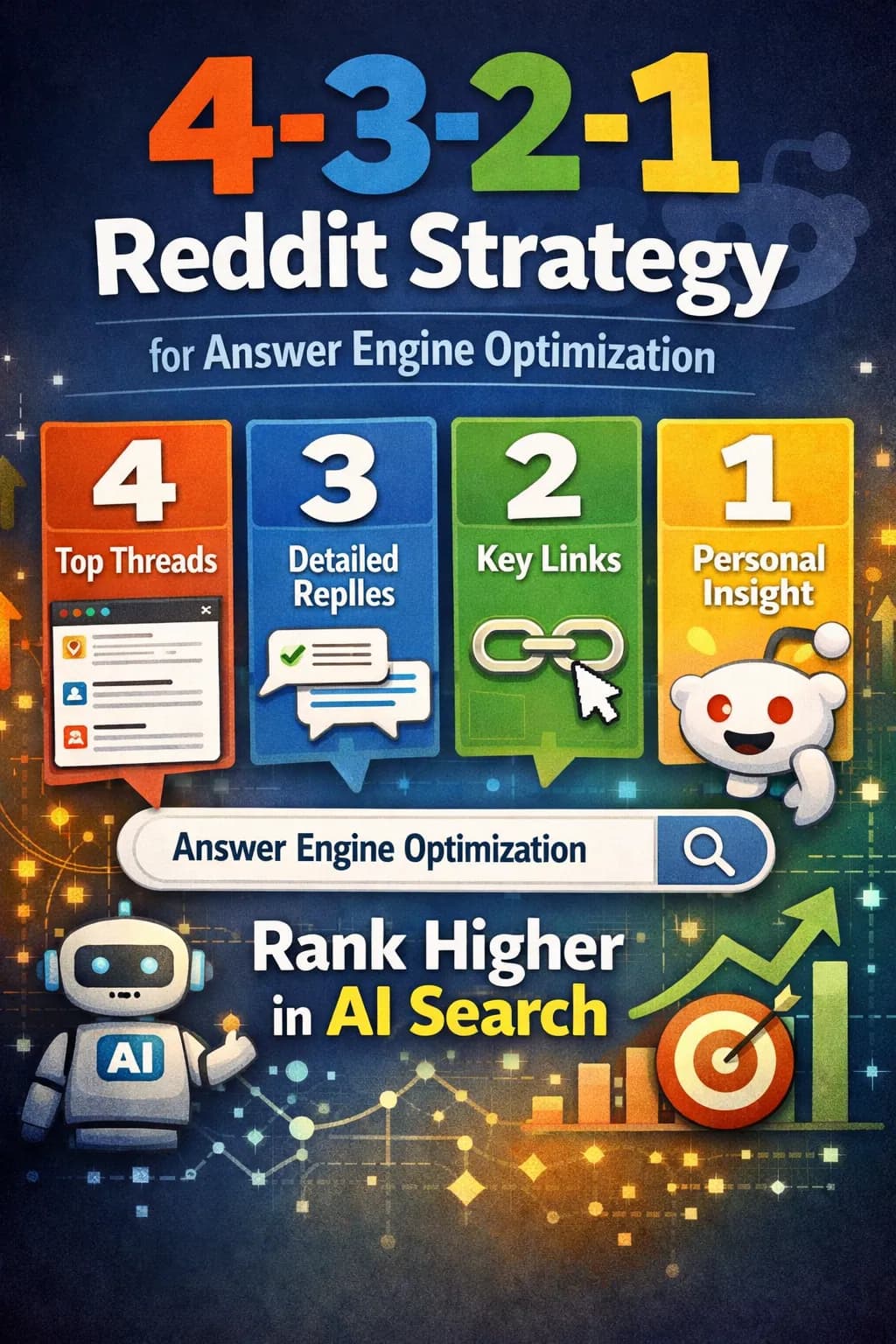
The 4-3-2-1 Reddit Strategy for Answer Engine Optimization
A proven Reddit formula to build authority and drive traffic through AI search engines.
Read more